
Everyone knows how to change a car’s air filter. You drive to a local garage, and the job is done in 15 minutes. But applying the same logic to the excavator on your construction site could be a serious mistake. In heavy equipment, an air filter is an entirely different engineering challenge — and failing to understand that difference can lay the groundwork for engine failures worth hundreds of thousands.
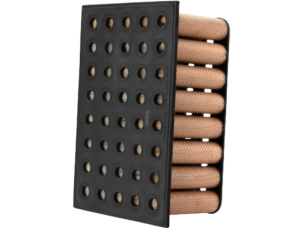 Why Is the Air Filter So Critical?
An engine needs air to run. For every litre of fuel burned in the combustion chamber, approximately 15 litres of clean air are required. If that air contains dust, sand, silica particles, or organic matter, these contaminants enter the engine and create an abrasive effect on piston surfaces, cylinder walls, and bearings.
According to industry data, particulate ingress causes approximately 45% of premature powertrain failures in excavation and heavy equipment. In other words, nearly half of all heavy equipment engine failures are directly linked to inadequate air filtration.
Key Differences Between Automotive and Heavy Equipment Air Filters
To understand the difference between these two filter types, it helps to first compare the environments in which they operate.
A passenger car in city traffic typically runs for 1–2 hours per day. It faces relatively low dust concentrations and operates in a controlled environment under stable engine loads.
A construction site excavator, by contrast, runs 8–12 hours per day — often in environments where silica dust concentrations reach 15–25 g/m³. In cement plants, mining sites, and agricultural fields, dust loads can be tens of times greater than those in a typical automotive environment.
Size and airflow capacity: A passenger car engine processes approximately 200–400 cubic metres of air per hour, while a large excavator engine may consume well over 1,000 cubic metres per hour. This is why heavy equipment air filters must have significantly greater surface area and dust holding capacity.
Filter media: Automotive filters are typically made from cellulose-based paper media, while heavy equipment filters are commonly produced from synthetic fiber, nanofiber-coated, or multi-layer composite media. These materials capture finer particles and offer far greater dust holding capacity.
Design: Automotive air filters are generally single-element, flat panel, or cylindrical in design. Heavy equipment uses a two-stage system with a primary filter to capture large particles and a safety filter to protect the engine if the primary element is damaged or bypassed.
Pre-cleaning systems: Many heavy equipment air filtration systems incorporate a cyclonic pre-cleaner that ejects approximately 92% of large particulates before they reach the main filter element. This layered approach extends service intervals by up to 65% compared to single-element designs, based on field tests conducted across hundreds of CAT and Komatsu machines.
Dust Load: The Numbers Tell the Story
| Feature | Automotive Filter | Heavy Equipment Filter |
|---|---|---|
| Daily operating hours | 1–2 hours | 8–12 hours |
| Dust concentration | Low | Very high (15–25 g/m³) |
| Airflow rate | 200–400 m³/hour | 1,000+ m³/hour |
| Replacement interval | 15,000–20,000 km | 250–500 operating hours |
| Filter structure | Single element | Dual element + pre-cleaner |
| Filter media | Cellulose | Synthetic / nanofiber |
A Common Mistake: Choosing the Wrong Filter for Heavy Equipment
One of the most frequently encountered situations in the field is this: an equipment owner opts for a cheaper aftermarket filter instead of the OEM-specified element. What appears to be a cost saving in the short term can have serious consequences if the filter’s dimensions, sealing design, or media quality fail to meet OEM specifications.
Heavy-duty truck air filters and heavy equipment filters differ in size, airflow capacity, and design — they are not interchangeable. Using an incompatible filter directly reduces engine efficiency. Worse still, if the filter does not seal properly within its housing, contaminants bypass the element entirely and reach the engine — as if the filter were not there at all.
Donaldson PowerCore® Technology: How Industrial Filtration Has Evolved
Donaldson crossed an important threshold with its PowerCore® technology, developed specifically for heavy equipment applications. This system transforms the traditional cylindrical filter structure into a compact, dual-stage unit that reduces size while improving filtration performance. Donaldson Blue® fine fiber technology extends engine and filter life significantly compared to conventional cellulose filters, offering superior protection in the most demanding construction and mining environments.
Kaya Group Filtration Systems’ own brand, Weraus, was developed specifically for Turkey’s demanding field conditions. With nanofiber-coated filter media, Weraus heavy equipment air filters deliver long service life and high dust holding capacity for applications where standard filters consistently underperform.
When Should Filters Be Replaced? How to Read the Restriction Indicator
Most heavy equipment is equipped with an air filter restriction indicator that measures the pressure differential created by the filter element. When the indicator enters the red zone, filter replacement is mandatory.
As a general guide:
- Heavy equipment (excavators, loaders, etc.): every 250–500 operating hours
- Very dusty environments (mining, cement): shorter intervals, restriction indicator monitoring essential
- Trucks and generators: 500–1,000 operating hours or once a year
These figures are general guidelines — always refer to your machine’s manufacturer manual first.
Summary: 5 Critical Differences
- Dust load — Heavy equipment filters handle tens of times more dust than automotive filters
- Airflow capacity — Designed for significantly higher air volumes
- Dual-element system — Primary + safety filter; automotive typically uses a single element
- Pre-cleaning — Cyclonic pre-cleaner ejects up to 92% of large particles before they reach the filter
- Replacement frequency — Determined by operating hours and restriction indicator, not kilometres
Correct filter selection and timely maintenance protect your equipment’s engine, reduce fuel consumption, and prevent unplanned downtime. Contact Kaya Group Filtration Systems’ technical team for expert guidance on selecting the right air filter for your equipment.