
What Do the Filters in Your Hydraulic System Do?
An excavator’s arm movement, a tractor’s front loader, a crane’s lifting capacity — all of these rely on the same technology: the hydraulic system. Yet the silent guardians of these systems — hydraulic filter types — are often only remembered when something breaks down. Research shows that 70–80% of hydraulic system failures are caused by oil contamination. Understanding the different hydraulic filter types and their functions is the first step toward protecting your equipment and reducing maintenance costs. In this guide, we explain what every filter in your hydraulic system does and why it cannot be neglected, drawing on Donaldson’s technical expertise.
 Why Are Filters Essential in Every Hydraulic System?
 Why Are Filters Essential in Every Hydraulic System?
The perfect hydraulic system would feature filtration at every point in the circuit — before and after every component. In reality, cost, physical space, and the added pressure on the system limit how many filters a machine can accommodate. Manufacturers must therefore design systems that are both efficient and cost-effective.
The factors that determine which hydraulic filter types are needed in a system:
- The cleanliness requirements and sensitivity of components
- Ambient contamination
- The duty cycle of the equipment
- Ease of maintenance and spare parts access
- Other variables that differ from application to application
Hydraulic Filter Types and Their Functions
1. Suction Strainer
Located inside the hydraulic fluid tank. Its primary function is to prevent large contaminants — insects, bolts, nuts, and other foreign objects — from reaching the pump. It can technically be eliminated by keeping the tank sealed and using a return-line filter. However, no matter how unlikely it may seem that such objects could enter the reservoir, a low-cost suction strainer could save an expensive hydraulic pump from catastrophic damage. In some cases it also helps prevent air bubbles from entering the hydraulic circuit. This is one of the most basic hydraulic filter types in any system.
2. Suction Filter
Positioned between the reservoir and the pump, designed to protect the pump from harmful contaminants. It stands out for ease of service and low cost. However, to avoid restricting the pump’s suction line — and to prevent cavitation (the formation of vapour-filled cavities) — it tends to be significantly larger than return or pressure filters with the same flow rating.
3. High-Pressure Filter
Cleans the fluid delivered by the pump. It protects expensive downstream components such as servo valves and actuators, and safeguards the circuit in the event of a catastrophic pump failure. Found in a vast range of applications including tractors, construction and mining equipment, and forestry machinery. Among all hydraulic filter types, high-pressure filters face the most demanding operating conditions.
The housings for these filters must withstand pressures of 6,000 psi or higher, making them heavy and difficult to handle. Unless a duplex configuration is used and strict safety practices are followed, the entire hydraulic system must be shut down before servicing.
4. Return Line Filter
Features low- or medium-pressure housings, making it less expensive than its high-pressure counterparts. It collects contaminants from the oil as it returns from valves and actuators towards the reservoir. Highly versatile — these filters can be positioned almost anywhere within the return line circuit.
Their sensitivity to flow surges can degrade performance, so return line filters must be sized for the maximum anticipated flow. They are particularly effective at removing contaminants that enter the system through actuators such as piston rods.
5. Breather Filter
Prevents atmospheric or airborne contamination from entering the hydraulic reservoir. Air enters the reservoir whenever the fluid level drops — during normal machine cycling and when fluid cools during idle periods. Breather filters stop particles larger than 3 µm from entering the system.
According to Donaldson’s technical assessment, breather filters probably offer a greater benefit for their cost than any other hydraulic filter type. Yet this component is often forgotten during service — despite being critical to the hydraulic system.
6. Off-line Filter (Kidney Loop)
Achieves very fine filtration by maintaining steady-state flow, whether or not the main hydraulic system is running. Kidney loop circuits often include a heat exchanger to keep hydraulic fluid within an optimum temperature range. The entire hydraulic system can continue operating while the kidney loop filter is being serviced.
Its disadvantage is that it operates outside the hydraulic circuit — meaning it does not directly protect components — and usually requires an external power source nearby.
Hydraulic Filter Types: Spin-on or Cartridge-Bowl?
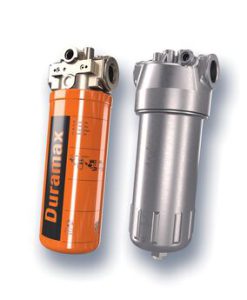
With a spin-on filter, the head is threaded so it can be spun on and off. The cartridge-bowl construction involves a separate head and housing, with the element sitting inside the lower bowl section.
Replacing a spin-on filter means discarding the entire element — faster and simpler, but replacement elements are more expensive. Replacing a cartridge-bowl element produces less waste, is more environmentally friendly, and the element cost is lower. Choosing between these two hydraulic filter types depends on the trade-off between build cost, operating cost, environmental impact, and serviceability.
Donaldson Synteq™ Media Technology
Donaldson’s hydraulic filters use Synteq™ synthetic filter media, featuring smooth, rounded fibres for low resistance to fluid flow. The high-efficiency media grade delivers consistent performance throughout filter life and excellent fluid compatibility. The epoxy-coated steel support mesh provides excellent pleat support and spacing for maximum effective media area, while protecting the media from damage during handling and installation.
Conclusion: A Hydraulic System Without Filters is Unthinkable
The machine in your workshop could feature all or some of the hydraulic filter types described above. Without stripping a machine down, it is often impossible to tell which filters have been specified by the manufacturer. It is essential that every owner and operator of machinery with built-in hydraulic systems understands the vital preventative role of filtration and regular maintenance. Specifying the right hydraulic filter types — in line with the manufacturer’s individual recommendations — is not just best practice; it is usually the more economical choice for the equipment owner.
As Turkey’s official Donaldson distributor and authorized dealer for world-leading brands including Argo-Hytos, Filtrec, and Parker, Kaya Group Filtration Systems provides hydraulic filtration solutions tailored to your facility and equipment needs. Contact our technical team for expert filter selection guidance.
Source: Donaldson Company, Inc. — “What do the filters in your hydraulic system do?” Technical Guide (F111616, 02/20)